

Author’s note: I was traveling and took a personal week off. That’s why I’m combining news from the past few weeks into a single edition.
Signals
India- and US-based hardware startup Aina launched its AI ring with a screen, joystick, mic, and speaker. You can take calls, control apps, start agent work, and dictate on your Mac with the $499 device.
Despite having a physical control ring, its functionality relies a lot on voice. In the next year, we will see rings like Sandbar Stream, Pebble Index 01, and Natura take on Aina with different form factors. For some, having a lot of features might be an attractive part of the ring; for some, it would be a turn-off.


Based on these trends, we could see a lot of rings trying to be the best input mechanism for voice for notes, agent control, and dictation.
In Focus
Rise of local models
A large amount of voice tooling is centered around cloud-based models used for transcription, knowledge extraction, or just cleanup. In the last few months, the demos and models released by various labs indicate that we could have more local options in the coming year.
Block released its great-sounding speech-to-speech model Dessa, which can run on a MacBook M4 Max. Gradium released Phonon, a speech generation model sized 70 MB, which can support five languages and over 100 voices.
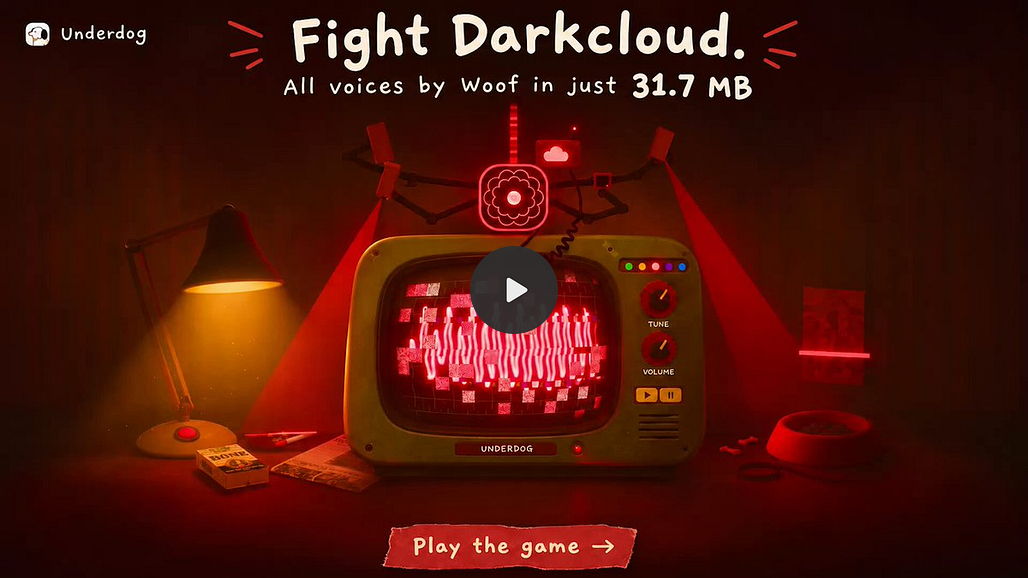
But there is more miniaturization. Underdog AI released a new model called Woof this week in a new demo showing speech generation through an interactive experience. You can type on the typewriter in the demo to generate speech, or change the radio station to create a new song. All of this can run in a browser thanks to a 32 MB model.

There is similar movement on the speech-to-text side as well. Underdog released its Bark transcription model of 163 MB; meanwhile, Nvidia launched the new Nemotron model. Google made its small models available in the AI Edge Gallery app.
All of these models, except for Dessa, can run on average consumer phones, laptops, desktops, and other devices. These models might not be as capable or expressive as the ones living in the cloud from ElevenLabs, Deepgram, Soniox, Fish Audio, and Cartesia. However, for consumers, they can enable tools like transcription, dictation, meeting notetaking, local assistants, and more at a reasonable accuracy level.
Until now, most open-source tools had to pick from a few options like Nvidia’s Parakeet or OpenAI’s Whisper for speech-to-text. Slowly, that is changing. And the speech generation models can help people use an ever-present assistant.
An average user might still opt for a full-featured product, but an increasing number of local models will give users the choice to go for features that can run without the internet. Plus, a lot of cloud-based providers lock down data unless you pay for a subscription. With local models, users can own data like transcripts and weave them into model workflows easily.
“I think that it's very important that people own their data, they own their AI, and it's local, and it's secure. Because if it's offline and it's not on some Linux server and some database, then it's significantly safer than everything out there that's getting hacked right now,” Underdog’s founder Sigil Wen told me.
Local models can also help apps have a fallback in case their cloud version doesn’t work or if users are in a low-network area. The movement towards more open-source models is a good one.
ElevenLabs plays a market capture game
Deepgram’s acquisition of Pipecat maker Daily was an infrastructure play. ElevenLabs is taking another approach by capturing markets geographically and in the software stack. In the last few weeks, the company acquired a Japanese voice AI company called Kotoba, released new speech-to-text models in the Scribe series, announced new products for agent building and memory, and created a new meeting notetaker + dictation tool with an enterprise focus.
The company, at its Jensen Huang-less 11/11 conference, announced a few ecosystem initiatives as well. First was the partner program that lets consultancies like McKinsey work with enterprises to deploy voice agents. Most of the time, enterprise readiness is the problem with companies adopting AI tools, and that results in the failure of pilots.
There is also a marketplace of agents built by companies like Zendesk, NiCE, Consio, IBM, and Assort Health. Companies can use these agents and contact the makers for further implementation, having the marketplace act as an acquisition funnel.
ElevenLabs is already a giant in voice AI, and it might not directly want to move into other modalities. However, creating a consultancy, implementation, and agent platform is the way to go to expand its presence without developing all capabilities internally. It is like saying we are a CX player without being a Decagon or Sierra.
Quick Bytes
Subvocal posted a demo of its glasses that can potentially detect silent speech. We would see much more of this in 2027.
Scammers are cloning friends’ voices to trick users in India into giving money. In two recent incidents in Kolkata and Nagpur, users have lost nearly $110,000.
Hume launched an audio decision API, which can detect the intent of speech. In a demo the company showed, organizations can understand the number of speakers and how they are talking.
Meta rolled out real-time voice calls for Muse, so users can talk to their agent live.
Hugging Face refreshed its OpenASR leaderboard with Nigerian and Egyptian accents.
Twilio’s new voice AI stack update includes a way to switch STT providers on failure and HD voice for better quality.
Suno released a new model based on Minimax to produce music videos.
Jordan Belfort, of ‘The Wolf of Wall Street’ fame, has a new voice AI startup that has his sales chops.
Deals Corner ($616.4 million)
Guava ($12.5 million Seed): Full-stack developer platform for building production-grade AI voice agents, with its own speech recognition, language models, and voice synthesis. Total funding now stands at $12.5 million.
Investors: Acrew Capital (lead); Flourish Ventures, WillowTree Ventures, Clocktower Ventures, Commerce Ventures
Nooks ($500 million financing commitment): AI voice platform for sales teams whose agents dial, sequence, follow up, and prep deals alongside reps. Total funding now stands at $570 million.
Investors: General Catalyst (Customer Value Fund)
Helix ($6.2 million): New York startup building on-device voice ID that verifies a user is human and estimates their age from a four-second voice challenge, as a privacy-preserving CAPTCHA replacement. Total funding now stands at $6.2 million.
Investors: Chicago Ventures (lead); BAM Ventures, Aglaé Ventures, Corazon Capital, Press On Ventures, Tusk Ventures, Yonder Ventures, Rule 30, Brown Angel Group
Linq ($90 million Series B): Builds infrastructure that gives AI agents phone calling, messaging, and computer-use access, so businesses can reach customers’ AI agents directly. Total funding now stands at over $120 million.
Investors: Andreessen Horowitz (lead); TQ Ventures, Mucker Capital, Abstract (existing); Anthos Capital, Left Lane Capital (new)
Laronix ($5 million Pre-Series A): Makes the Bionic Voice, a wearable AI voice prosthesis that recreates a patient’s own voice from 10 seconds of audio for people who lost their voice to throat cancer or Parkinson’s. Total funding now stands at roughly $7 million.
Investors: No lead disclosed; Seefeld Investments, 12 Ventures (firms); angels Elaine Saunders, Peter Blamey, Kristy Chong
Wilco ($2.7 million / €2.5 million, round type not disclosed): Builds AI voice and messaging agents that handle patient follow-up for healthcare clinics across Europe. Total funding now stands at $2.7 million (first disclosed round).
Investors: Samaipata (lead); ABAC Nest Ventures and tech angels
Acquisitions
CX platform Five9 acquired conversation intelligence platform Level AI.
Salesforce acquired Cresta, which is a platform to combine both AI and human voice agents.
ElevenLabs acquired Japanese voice AI company Kotoba.
Thank you for tuning in. Keep listening.
This newsletter is by Ivan Mehta, a freelance reporter at TechCrunch. It covers AI and technology in voice, audio, and music. Email: voiceaiweek@gmail.com or im@ivanmehta.com