

I am Ivan Mehta, a consumer tech reporter at TechCrunch. For more than a year, I have covered different aspects of voice AI. This newsletter is an experimental attempt at covering what is happening in this industry, which is growing at a rapid pace.
Top News
Voice AI had a blockbuster Q1 with over $1.90 billion in funding
Edit note: the post is updated with funding of hardware startups like Sandbar and Taya
Voice AI had a stellar quarter ending March with more than $1.88 billion, according to our funding tracker, secured in funding by voice AI companies, including startups that use voice as a prime modality, along with others such as text and videos.
While ElevenLabs’ $500 million Series C round was the biggest round, January was the top month with over $1.1 billion in funding secured counting major rounds of Deepgram, Parloa, and Decagon.
Notably, after a bright start in January, the funding has dwindled in the voice sector in the following months. This is possibly a signal of termsheets signed late last year and deals being announced early this year. We might see this pattern repeat in the next quarter.
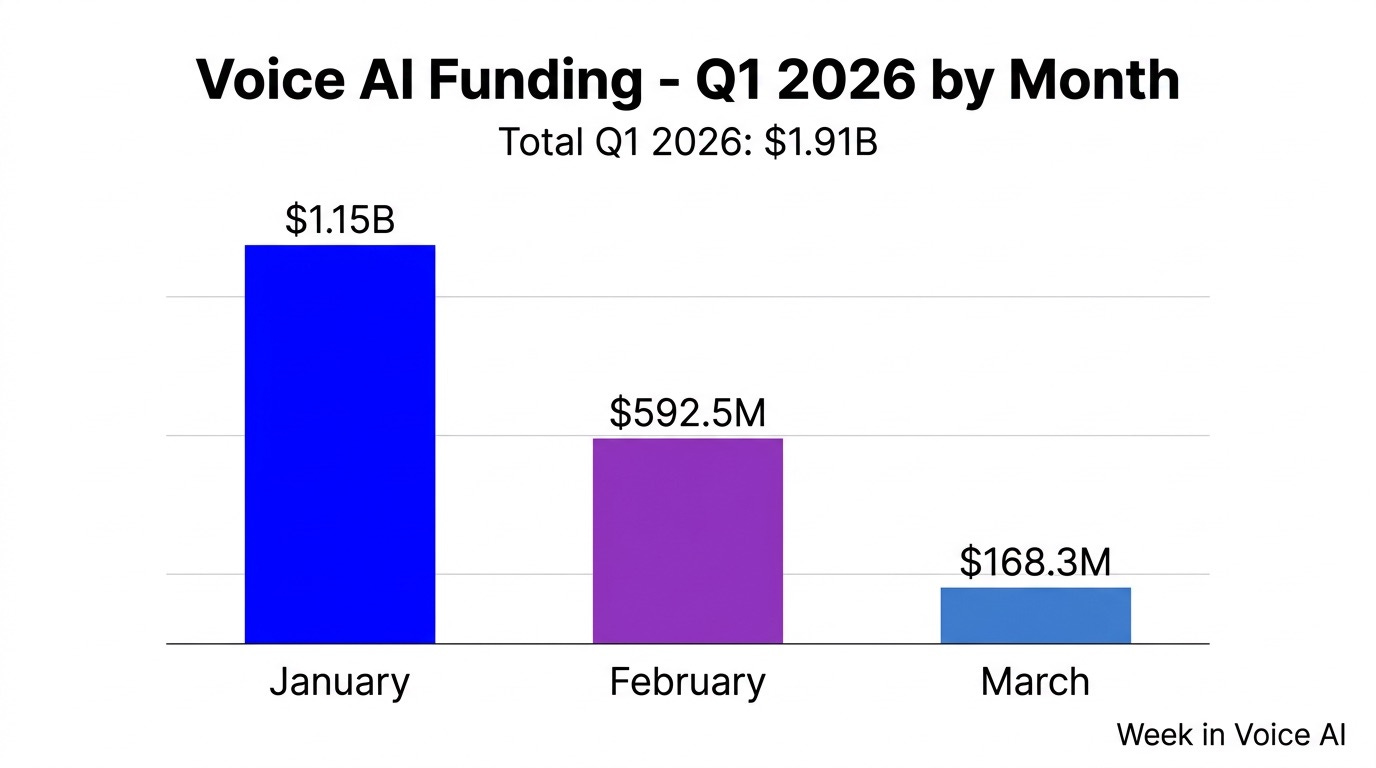
Most startups saw their valuation soar. However, we saw three new unicorns minted this quarter: DeepGram, LiveKit, and Granola.
ElevenLabs had the biggest funding round of the quarter, with Parloa’s $350 million and Decagon’s $250 million.
Notably, most funding was concentrated on either end of the deal size. There were seven $100 million+ deals, and all the other deals (save Slang AI’s $36 million round) were under $30 million.
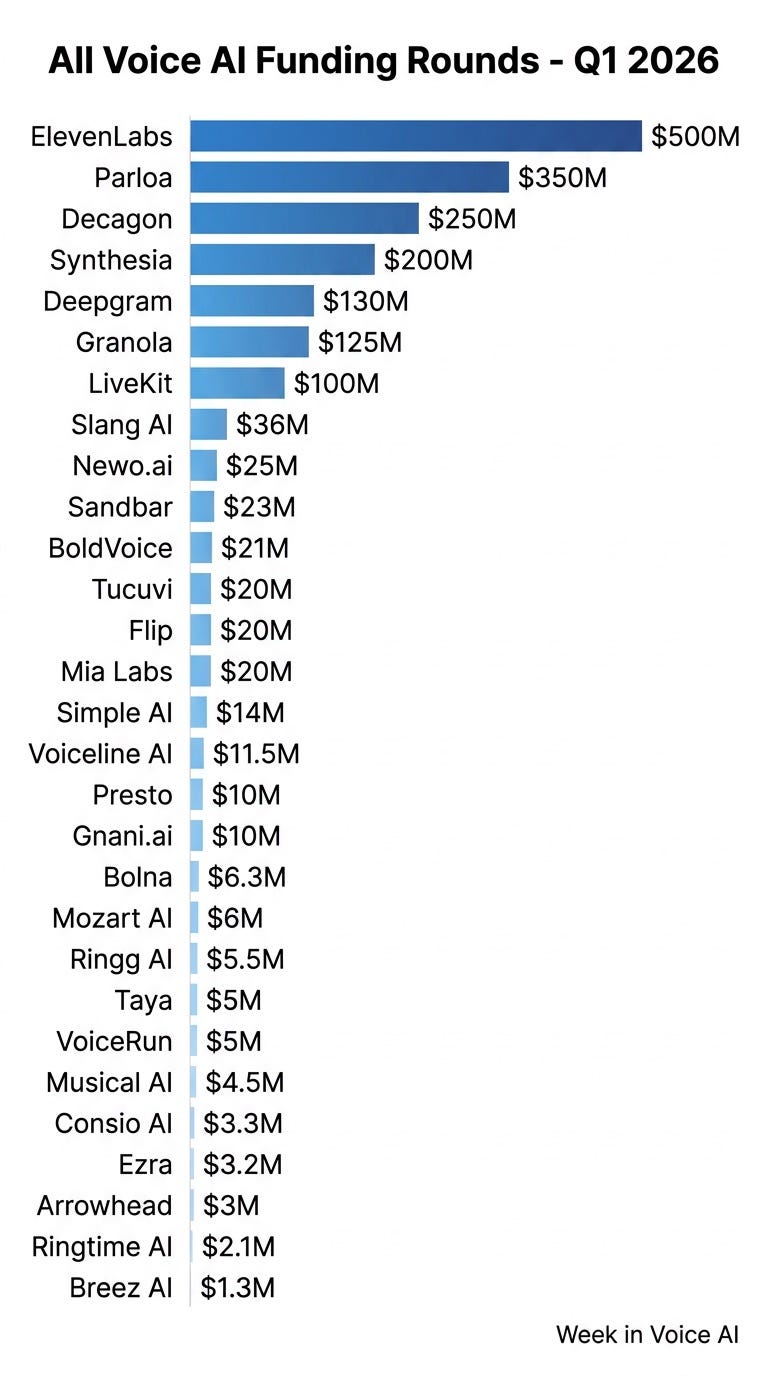
Some of the larger rounds went towards model makers, infrastructure providers, and consumer support. But venture capitalists wrote smaller checks to verticalized companies concentrating on sectors such as recruiting, food (quick service), health care, and finance. There is hardly any consumer action, barring Granola (more of a prosumer and enterprise play now) and BoldVoice.
Index Ventures, Y-Combinator, NVentures (Nvidia), Accel, Altimeter Capital, and Wing VC were some of the active investors in the sector with more than one deal.
Interestingly, Evantic was in two mega deals, including ElevenLabs and Synthesia.
Model Behaviour
Microsoft launches new voice models
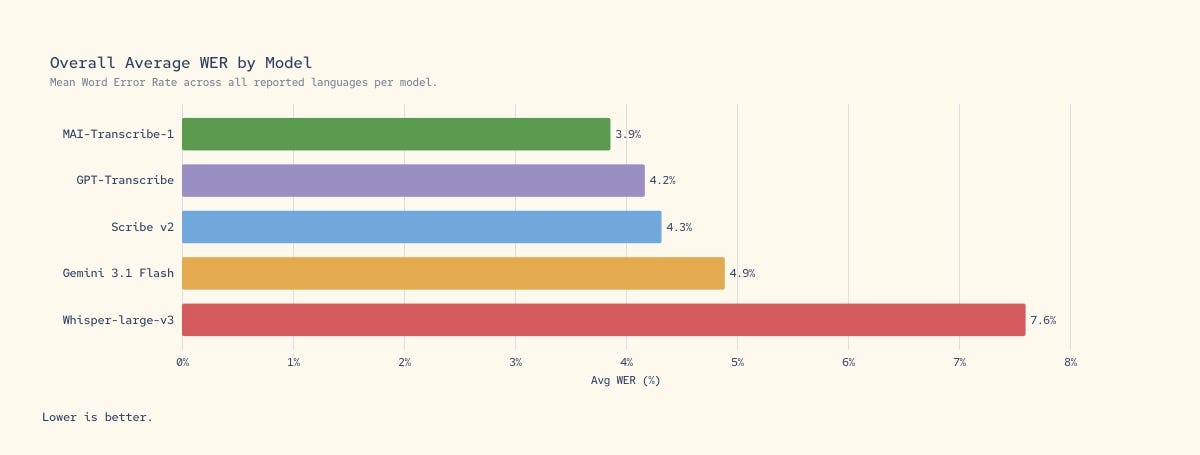
Microsoft released three new models last week, with its speech-to-text model being the marquee release. The MAI-Transcribe-1 supports 25 languages and outshines Azure Fast by being 2.5 times faster. The company claimed that the model’s Word Error Rate (WER) was 3.9% on the FLEURS dataset, and outperforms others in 11 core languages.
Microsoft also released MAI-Voice-1, which could generate 60 seconds of audio in one minute. The company said that the model needs up to 120 seconds of audio for cloning without any fine-tuning.
MAI-Transcribe-1 is priced at $0.36 per hour of audio, while the voice generation model is priced at $22.00 for 1 million characters.
ElevenLabs adds multilingual code-switching to its Scribe 2 model
ElevenLabs announced improvements to its Scribe 2 automatic speech detection (ASR) model. This includes Indic-English code-switching, which means when a speaker switches between languages like Hindi or Telugu to English, both parts are perfectly transcribed.
The upgraded model allows users to include almost 1,000 custom terms and phrases while sending audio for transcription, 10x more than the previous version. The upgrade also brings the ability to automatically remove certain entities, such as credit card numbers or names, from the transcription for privacy.
Quick Bytes
Speechify launched its Windows app, with a focus on processing everything locally, for transcription and voice-based reading of documents and articles
ElevenLabs launched its ElevenMusic app on iOS, along with a website for AI-generated music discovery
Miravoice AI raised $6.3 million for its tech that allows for conducting and analyzing long calls, such as interviews or surveys
Retell AI said this week that it is now handling 50 million calls per month
OpenAI launches CarPlay support for ChatGPT’s voice mode with iOS 26.4 rollout
Caller ID platform Truecaller crosses the mark of 500 million users per month, and gets to over 350 million users in India
Signals & Experiments
Days after public discourse around Granola locking its database down and breaking local agents, I got a note saying that my Granola plan has been downgraded. That was fine, but I also realized that it meant losing access to all transcripts stored over time.
I understand that the company needs to make money, but it would have been good to get a heads-up so I could extract my data. One idea that might work is a one-time fee for data extraction after a date set by the company for when you can get the data out.
I constantly test a lot of meeting tools for work. The cost of that is lost data or long context at times. Granola’s change and switching tools have made me look at open-source tools like OpenOats and Museli, along with closed-source tools like Talat, which has a one-time purchase fee.
While commercial tools are great for advanced features, they are concentrating more on team and enterprise use cases, and as a result, some of them are more expensive for individual users like me. Plus, long-term, I would like to have a database of my meetings from which I can extract information and insights.
Thank you for tuning in. Keep listening.
Email: voiceaiweek@gmail.com or im@ivanmehta.com