

Signals
There is a personal AI agent launching every day, and companies like Meta, OpenAI, Instinct, and Wajo are hard at work releasing new features. Amid all this, how agents communicate with different humans and systems still remains undefined. But in the last week, we saw some movement towards solidifying that.
CX companies Sierra and Decagon posted on X that they are working with various organizations, including Meta, Shopify, Stripe, a number of banks, airlines, and media companies. ElevenLabs was also on that list, which indicates that the voice AI company is interested in being a core part of forming a protocol that could govern how calls are made to or from agents.


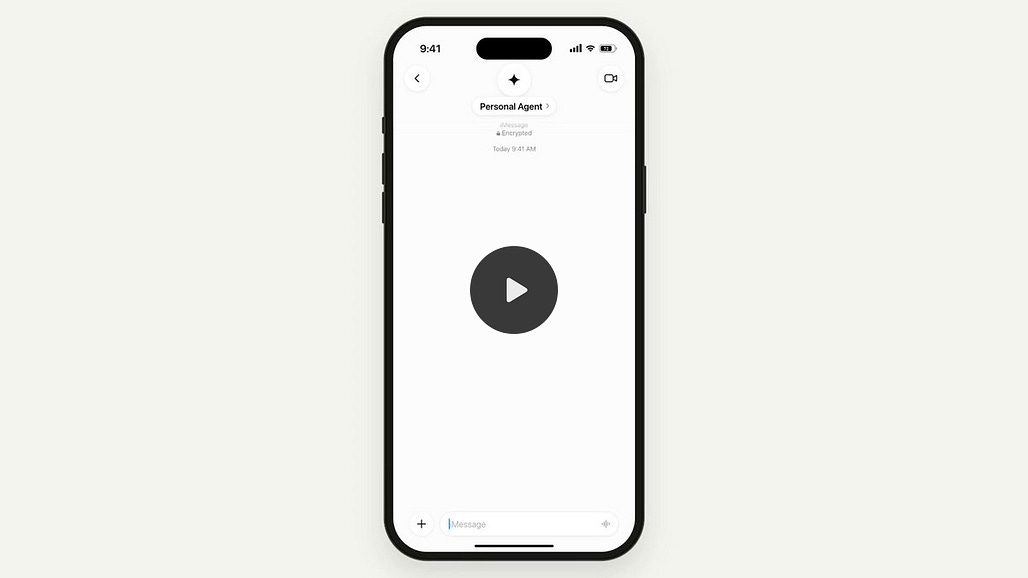
Notably, companies like Vapi have already started working on an infrastructure layer for agent calling. In the coming months, we will see more partnerships in the agentic calling area.
In Focus
Dispatch from ElevenLabs’ India summit
Earlier this year, ElevenLabs CEO Mati Staniszewski said that the company wants to reach $100 million ARR in India. At the company’s first summit in India, none of the executives mentioned this number, and there weren’t any marquee announcements. But there were plenty of indicators to suggest the company sees India as a key revenue driver.
The company has been slowly growing its investments and partnerships in India for a few years now. In conversations with company executives over the years, I have observed that the company wants to improve its language models and understand the country’s cultural dynamics to cater to different use cases.
ElevenLabs in India:
Over 250 enterprise clients
26,000 monthly API users
100 million yearly conversations on ElevenAgents
20 million customers reached
70% of interactions in local languages
2,700 voices supported by 700 voice actors
The startup began expanding and hiring formally in India in 2024. By then, it had partnerships in the enterprise and entertainment sectors. For one year, former YouTube exec Siddharth Srinivasan was at the helm of the country’s operations. The post is now held by Karthik Rajaram, who worked at Freshworks and Salesforce in growth and sales roles.
Besides that, the company has had crucial hires in go-to-market, public policy, events, sales, forward-deployed engineering, and product. Sales and go-to-market roles are very common for a foreign company setting up shop in India. But hiring engineering talent to contribute to global product is unusual at ElevenLabs’ scale. All of these are very calculated steps to achieve clear outcomes.
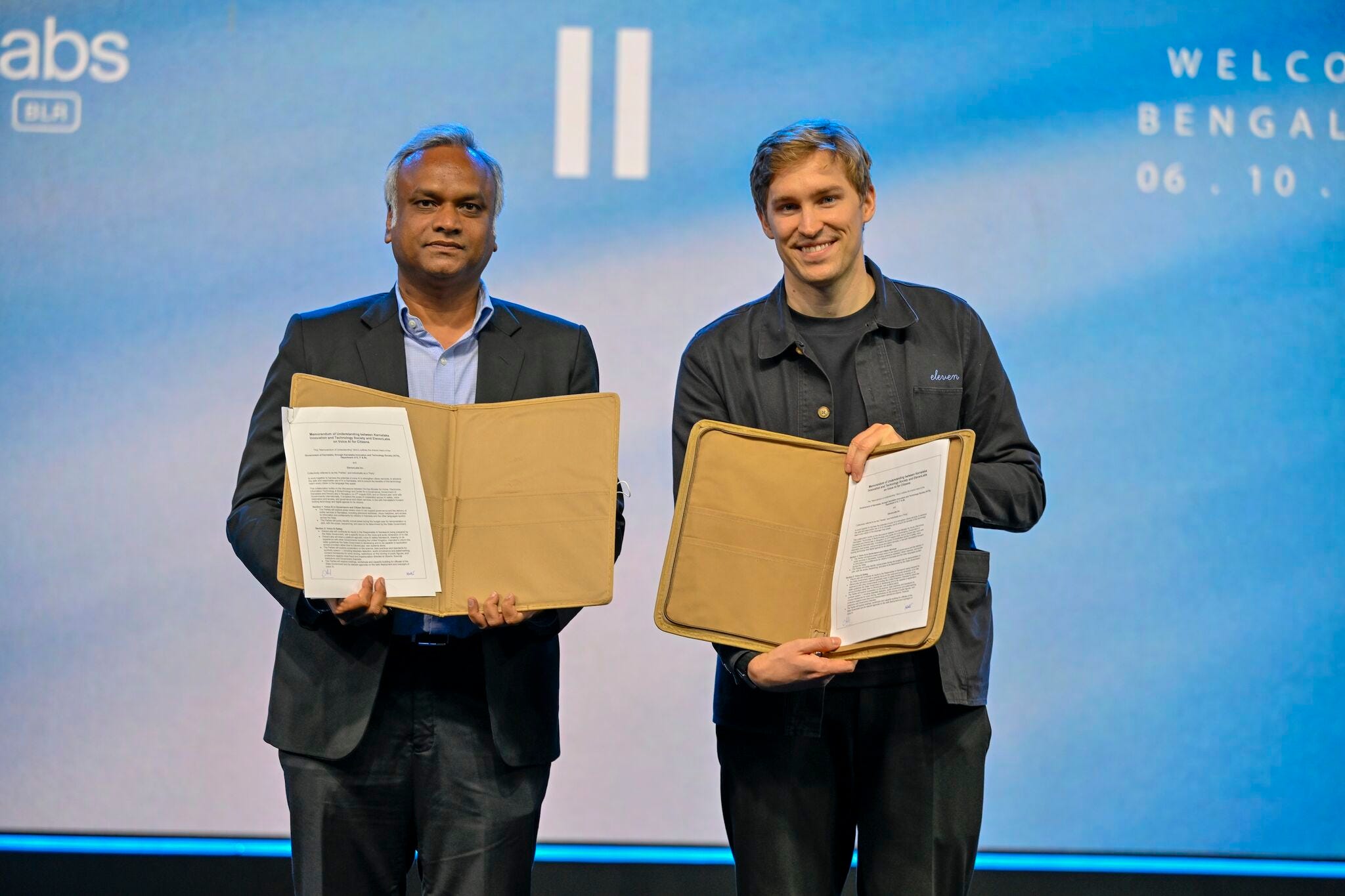
ElevenLabs signed a Memorandum of Understanding (MoU) with the Karnataka government to apply voice AI to government services. The announcement wasn’t a surprise, given that the state’s IT minister, Priyank Kharge, had a meeting with the India team a few months ago, and the company has been courting governments since earlier this year through a dedicated vertical.
For some, it was a surprise that Bengaluru-based Indian AI company Sarvam wasn’t the one getting a voice AI contract from a local government. Sarvam is one of the well-funded AI companies, but its $387 million total funding is less than the $500 million ElevenLabs picked up in one round earlier this year. So the fight isn’t totally fair.
Other US-based voice companies like Deepgram and Cartesia have built some presence in India, but their reach is not equivalent to ElevenLabs.
In India, you can’t just win by having great models. You need a well-oiled sales machine that can deal with the idiosyncrasies and requirements of the country’s enterprises, and ElevenLabs is winning at that.
Interviews
At the summit, I interviewed India GM Karthik Rajaram, Field CTO Alex Holt, and Growth lead Luke Harries. Here are some of the thoughts from them that could hint at what the company is thinking about.
Karthik Rajaram
On capacity building
When we started off, there were some use cases like outbound calls, which we were able to do a lot better. We work with a plethora of organizations across the spectrum of verticals, from financial services to consumer tech brands to healthcare. There were some straightforward use cases for us, such as EMI renewals.
Our agent orchestration is getting better in terms of being more deterministic and new calling and things like that. We are starting to see more complex use cases around customer service
How it plans to improve the way the models speak local languages
One is obviously customer feedback. We work with a lot of customers, and our volumes are large. Customers are going to hold us really accountable and going to keep us honest in terms of whether the AI voice is sounding human and natural and not, as you said, very bookish or very pure sort of a language. That’s not the way the language gets spoken.
We also have a massive voice library where we call in voice artists to speak different tonalities, accents, velocities, and emotions.
Alex Holt
On why ElevenLabs has a special “Hinglish” model toggle in its platform
It was really hard to configure our models and LLMs to have maximum accuracy and output for Hinglish. It took a lot of iterations of prompting and style, and working on tweaking our models’ configuration settings, so we could do that with our FDEs.
Adding the toggle is the feedback we produce; we needed to do this complex process that requires a lot of our knowledge, and what we want to do is make that available to everybody so that everybody who wants to use Hinglish can do that.
We distill all of that learning and put it into a toggle. Before the toggle, you could still achieve high accuracy in Hinglish, but it would take you a very long time to do that.
On handling calls from agents like Muse and Instinct
My firm belief is that consumers will adopt this technology very rapidly, and the enterprises that are not able to scale themselves with AI are going to see this [existential problem]. This is going to be existential for them because they’re going to see a huge influx of tickets, cases, and calls that they’re not going to be able to service.
I think in terms of solutions, there are lots of different kinds of approaches, but fundamentally you have to have the capacity to respond and treat those cases as if they were coming from customers, because at the end of the day, it’s the customers asking for that information. If you don’t answer their AI agent, the human is going to have bad service.
Luke Harries
ElevenLabs is creating a full-stack creative and marketing platform with ElevenCreative. Does it want to compete with Adobe and Canva?
I would maybe push that slightly on the Adobe Firefly and the Canva use case. I think it’s a different set. We’re definitely still strongest on the voice bit. That’s where you have this incredible library of all the voices. We combine all the best models.
We have the dubbing model, which is full end-to-end dubbing. We’re gonna have much tighter integration with the lip sync models and sound effects. Then we have all the best image and video models on day one as they come out to get to parity with other aggregator platforms.
Then there’s the next layer above, which is actually all the tools. And so Studio is a full browser-based video editor, which can be used for scratch work to full production. We are also seeing a lot of traction with Flows (the company’s infinite canvas creative product).
On scaling marketing use cases with ElevenCreative
The product that we’ve recently seen the most exciting enterprise adoption is called Creative Engine.
This is an end-to-end platform where you connect your ad platforms. It generates the briefs. Then your creatives can go into the loop, or use our own forward-deployed creatives, and then put them live.
Voice AI is still not commoditized
I think that’s probably something where we got the timeline. AI timelines are always tough. I think we got the timeline a little wrong on the voice quantised. I think we’re actually still a long way off.
If you think about the IQ and the EQ side of agents, the IQ side, I think we’re already there for what you need for great support and sales. I think the EQ side is where you can have this whole new unlocking differentiation.
On having creative people as investors, what does the company want to get out of them?
We’ve always had this philosophy as a company that wants to partner with the industry and doesn’t want to be antagonistic. We want to take the very best bits and help partner with them and accelerate their impact and their work.
Depending on the person, they get involved with the product side, the go-to-market side, or in our iconic voices marketplace.
Numbers Game
Call center jobs are going down rapidly because of AI, as per a report by a16z. The venture fund’s new report indicates that outside of China, call center jobs have plummeted all across the globe, and especially in lower-middle-income countries.


The graph sourced from workforce intelligence company Revelio Labs indicates that call center jobs are shrinking by 4% annually.
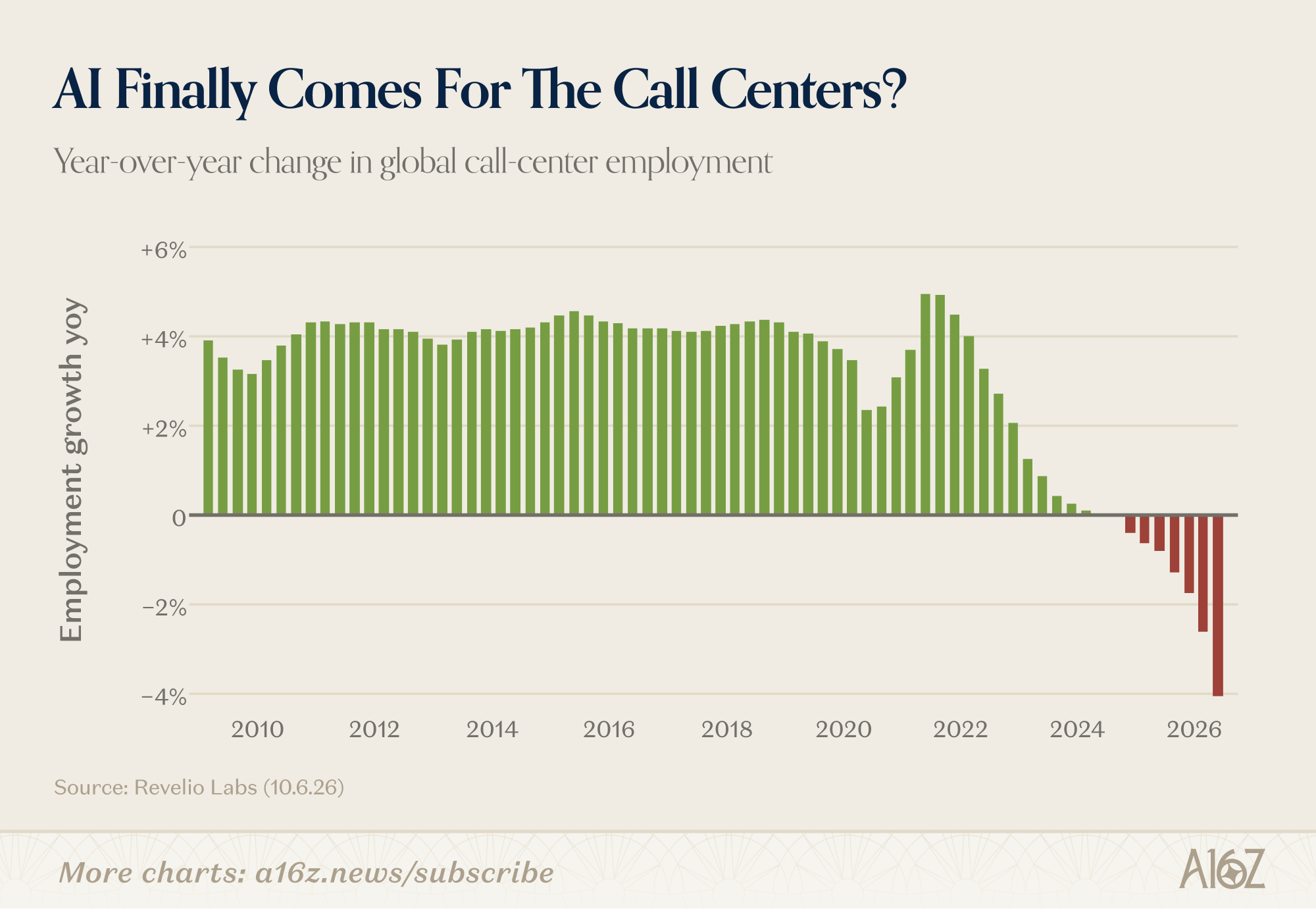
Given how voice AI and ticket automation are growing, it won’t be surprising if the numbers get worse.
In my conversations with capacity center execs and people working in the industry, until now, the stance was that because of AI we don’t need to hire more people, and instead enable the existing team to do more. Long term, AI can eat up some of the tasks done by humans, and the hiring rate can dip further.
Quick Bytes
Video company HeyGen released its own text-to-speech model with voice cloning ability.
Hume AI launched its expression measure API in a limited release.
The man who earned $18M from AI song fraud is sentenced to 18 months.
Elon Musk said that Grok will have music generation ability by partnering with Suno.
A Pindrop research report said that Meta’s Muse was calling before its public launch. The call volume has increased 8x in the last four weeks.
Apple acquihires the team behind Huxe, the app formed by the former NotebookLM team to build personalized podcasts.
Deals Corner
Stuut ($52.5 million Series B): The AI order-to-cash agent company automates collections, invoice disputes, and payment outreach across phone, SMS, and chat. Total funding now stands at $93 million.
Investors: Insight Partners (lead); Andreessen Horowitz and M12 (existing)
Flai ($27 million Series A): The YC-backed startup builds AI voice agents for car dealerships. The company said it clocks almost 50,000 dealership appointments every month.
Investors: Base10 Partners (lead); First Round Capital, plus strategic investors The Friedkin Group and Findlay Automotive Group
Vocca ($20 million Series A): The Paris-based startup that helps create AI phone agents for medical practices. It has scaled from 2,000 to over 15,000 practitioners over the past year.
Investors: Norrsken VC (lead); firstminute Capital and Speedinvest (existing)
Desible.ai ($3.7 million): The Bengaluru startup builds agentic voice AI for banking, financial services, and insurance.
Investors: Prime Venture Partners (lead)
Thank you for tuning in. Keep listening.
This newsletter is by Ivan Mehta, a freelance reporter at TechCrunch. It covers AI and technology in voice, audio, and music. Email: voiceaiweek@gmail.com or im@ivanmehta.com