

Signals
Fireflies, which has been primarily a meeting note-taker, announced its dictation feature last week, after launching an email product a few weeks earlier. Wispr made a similar move in the opposite direction, with the dictation app introducing meeting note-taking.
For voice-first apps, note-taking, dictation, and meeting note-taking are the core components of the stack. Tools like Speechify also include podcast generation and text-to-speech features.
One bet the likes of Fireflies and Willow are making is to make dictation free of cost or bundled into existing plans to keep users from switching over to other tools. Their bet is that speech-to-text models are commoditized enough to give them away for free.
Larger productivity companies aren’t really thinking much beyond meeting note-taking, as that’s a key part to enable automation.
The ultimate ambition for all these companies is to create an AI Assistant, which users can speak to, and it executes on their behalf. But there are too many moving parts to get even close to that.
In Focus
Enterprise firms are blindly adding AI to their CX platform, and that’s not good
The customer support and customer experience industry is undoubtedly the biggest adopter of voice AI technology. All the model makers and orchestrators are earning millions of dollars from enterprise contracts that involve calling customers. Some of that is to reduce call center costs; some of that is to increase revenue.
At first glance, it seems that AI-powered voice calls will dominate this field, and all of us as customers would be talking to AI agents. But reality is different. Whenever I have chatted with AI agents, the conversation is often clunky; they abruptly interrupt me and don’t have context about what I am talking about.
Every week, I’ve read about a new model company releasing a model that sounds “more human” than the company that made the same claim in the previous weeks. Given that there are so many benchmarks and evals, it’s hard to say where a particular model works in production and where it falters.
In any case, an industry doesn’t progress based on my personal opinion or anecdotal experiences. But multiple studies suggest AI in CX is not working as intended. Last year’s report from Qualtrics said that one out of five organizations didn’t see any benefits. Earlier this year, Gartner said that 50% of companies abandon these projects after the proof-of-concept stage. A report from Callminer said that only 24% of participating organizations said customers have a positive experience with AI.

NiCE CEO Arun Chandra told me on the sidelines of HumanX that there are external pressures on enterprises to adopt AI without showing enough readiness.
“However, most organizations are at scale; they jumped into doing an AI pilot because they came to a conference like the HumanX conference and think, “Oh my Gosh, I better do a pilot,” or their C-suite said, “Why aren’t you doing a pilot? What are you doing?” But if you get into a pilot without thinking about what the ultimate problem is that you’re trying to solve and what it will take to scale across the enterprise, your pilot remains captured in a corner, and that’s what has led to agentic slop in addition to AI slop in general,” Chandra said.
Chandra is not alone in this opinion. Numerous voice, CX, and enterprise executives told me in confidence that companies implementing AI still need to figure out a lot of processes and don’t expect a plug-and-play kind of experience.
In fact, Omilia CEO Dimitris Vassos thinks that not every customer process needs AI.
“We will use any available weapon to win the battle for customer service. Companies like Sierra, Decagon, etc. identify as generative AI companies. Their sole purpose is to deploy generative AI and limit themselves. You may have a bazooka, but if your enemy is near you, you need a knife. This is the reality of the contact center, where you need multiple tools,” he told TechCrunch during a fundraising interview.
Besides over-deploying AI, the second big problem AI in CX (or CX in general) has is the one of context. The company calls you and doesn’t know about your problem, despite you having communicated that earlier. And the moment that happens, the customer is frustrated, whether it’s AI or a human on the other end.
As someone who has worked in databases and reporting a long time ago, I know that bringing together different data sources and making them work in tandem is a different beast.
“To me, I think it’s [consistency of context] purely a function of how good the knowledge bases are. The effectiveness of an AI agent is literally gated by three things: online data, knowledge, and context. And context is what is created from the knowledge and data. I’m also driving the transformation of internal transformation in NiCE using AI. And one of the core jobs is to think about: how are we going to get a handle on all the unstructured data? Chandra told me.
On the stage of HumanX, Sierra’s Clay Bavor and Zendesk’s Tom Eggemeier emphasized that agents of any modality need customer context and to ground their answers in company knowledge and policy. Otherwise, agents can lead to failures that could cost the company more than losing a customer.
In an example of bad customer outreach, Heathrow Airport’s marketing director for the digital and eCommerce sector, Peter Burns, said that often businesses send offers to their customers that they can’t afford. He also mentioned that companies have greater ambitions than the state of their technology.
In the same session, Publicis Sapient’s Abby Godee said AI can’t replace deep customer insights, so at the end of the day, companies will still need to talk to their customers.
The pressure to implement AI won’t magically go away, given there is so much talk around this. However, given how intricate and complex enterprise processes are, companies will need to think before using AI in the right way. Otherwise, we will be stuck in a cycle where there are external celebrations and internal chaos.
Numbers game
ElevenLabs’ newest valuation shows the company’s rapid growth, going from $3.3 billion at the beginning of last year to $22 billion in roughly 21 months.
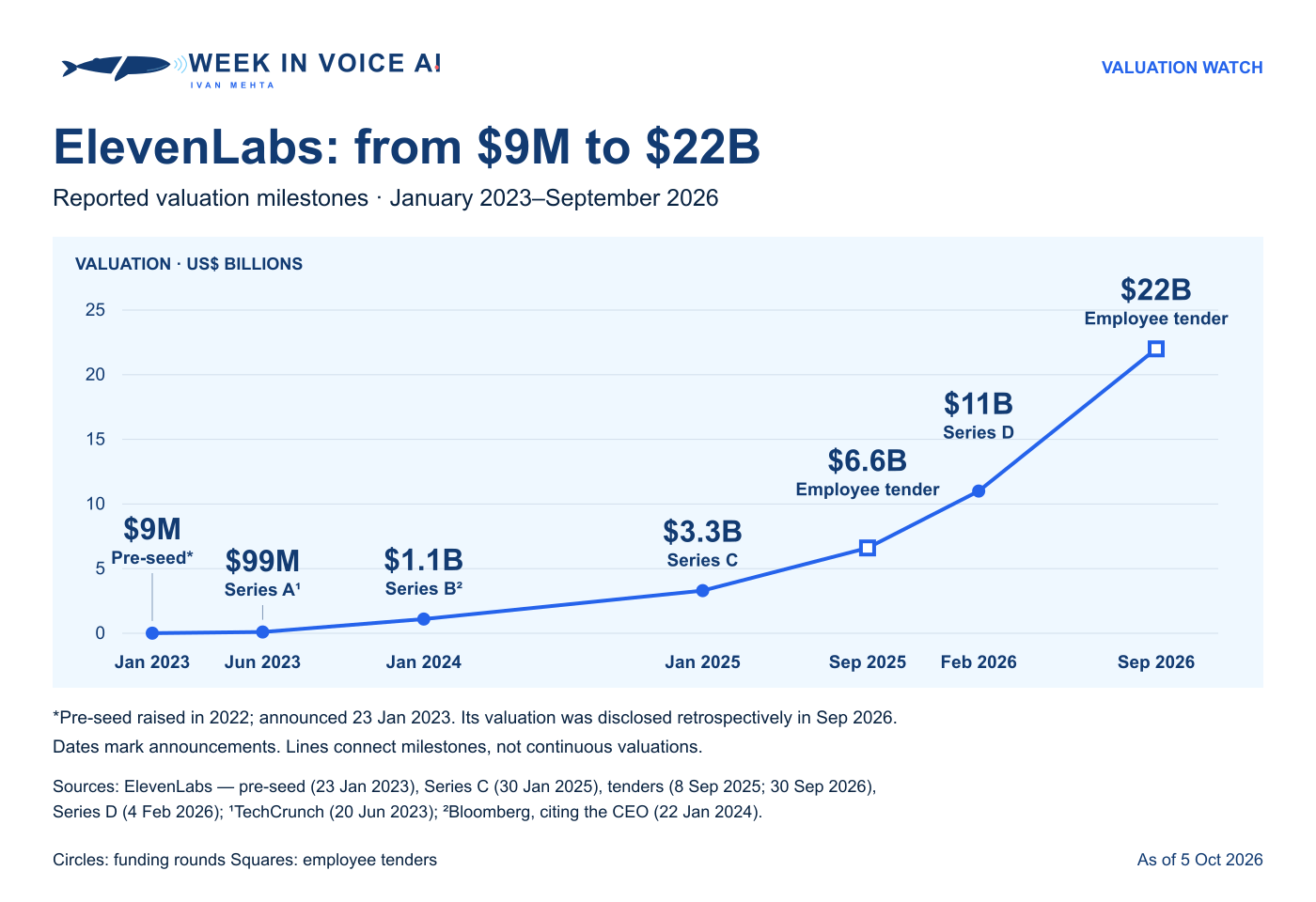
There are a few other numbers that indicate why the company is growing rapidly:
The company went from 330 employees to around 800 employees in less than 12 months
Conversations tripled from 5 million weekly in February to 15 million weekly in October.
Enterprise and small business revenue split is 55%-45%.
Quick Bytes
At the Bloomberg Screen Time Conference, CEO Mikey Shulman said that AI music generation app Suno has gone way past 2 million paid subscribers and $300 million annualized revenue, but didn’t give new numbers. He also added that there are no “firm rules of the road just yet” for AI music.
After voice actor Kenjiro Tsuda filed a complaint about his voice being cloned illegally, a Japanese court said last week that a human voice is protected. Other regions like China and the European Union have taken similar steps to protect voice.
Ultravox had raised $17 million in seed funding from investors including Redpoint Ventures and Madrona Venture Group. We might see more model companies acquiring established sales and agent layers to increase enterprise sales as the voice AI industry moves toward consolidation.
Microsoft launched its first live transcription model called MAI-Transcribe-2-Streaming with support for 60 languages. What’s more, introduced MAI-Voice-2.1 and MAI-Voice-2.1-Flash text-to-speech models with lower latency and better support for languages. Microsoft wants to be a serious contender in the enterprise voice stack by competing on price and wider availability.
Meta is not the only company looking to add audio glasses to its portfolio. Hearing tech company Legato uses AI to enhance relevant sounds and reduce noise. The new pair weighs just 34 grams, with battery lasting 10-12 hours.
Deals corner
ElevenLabs ($300 million employee tender offer at $22 billion valuation): The marquee company of voice AI hasn’t stopped growing. Its valuation has doubled just this year from $11 billion to $22 billion.
Investors: Wellington Management and T. Rowe Price (co-leads), Goldman Sachs, EQT, GIC, Ontario Teachers’ Pension Plan, Sapphire Ventures, BDT & MSD Partners (new); a16z, Lightspeed, ICONIQ, D.E. Shaw, Evantic, Disruptive, Alkeon (existing)
Modulate ($25 million): Voice intelligence for moderation, deepfake and scam detection, along with analysis.
Investors: Future Ventures (lead), Hyperplane, Lakestar
Presto ($10 million): Voice AI for drive-thru and restaurant phone ordering, serving major QSR brands.
Investors: Remus Capital-affiliated investors and existing backers
Deepslate (€7.7M / ~$9 million): Berlin startup building “Opal,” a full speech-to-speech voice model deployable on EU-hosted/on-prem infrastructure
Investors: 42CAP (lead), Alstin Capital, SIVentures, angels
Klang (SEK 15M / ~$1.5 million): Swedish startup transcribing, summarizing, and analyzing human conversations with compact in-house speech models
Investors: Private investors including Johan Lenander, Emil Sjödin, Daniel Gadd (no institutional lead)
Thank you for tuning in. Keep listening.
This newsletter is by Ivan Mehta, a freelance reporter at TechCrunch. It covers AI and technology in voice, audio, and music. Email: voiceaiweek@gmail.com or im@ivanmehta.com