

Editor’s note:
I am traveling this week with a packed schedule, so I am skipping the Quick Bytes section.
Please share the newsletter on socials if you like a story; that helps my newsletter grow.
Signals
Personal agents like Instinct, Wajo, and Muse are in vogue. For a few weeks now, people have been asking for the ability to call in some of those agents. Instinct and Meta’s Muse shipped that feature last week. These agents can call on your behalf, with some of these restricted to calling businesses. I tried calling a friend through one of the assistants, and there wasn’t enough disclosure to inform them why an agent is calling them.
As agents handle more calls on behalf of users, two things need to be worked out. First, agents would need enough disclosures to receivers while specifying why they are calling. Second, enterprises will need to figure out how to handle incoming AI calls. As SLNG’s Luke Miller pointed out to me, small businesses that might be answering calls manually would also need to prep for AI calls and have to implement AI solutions themselves. In the coming months, we will see a lot of AI-to-AI calling standardization and pipelines.
In Focus
There are too many meeting recording tools, so it is time for anti-recording tools
Recently, I tested a new meeting notetaker device called the Vocci Ring. It works similarly to other card-styled or pendant-like notetakers. But one thing that made me uncomfortable was that unless I declare to others around me that I am recording, the device’s design and faint light wouldn’t give them an indication, and they might think it was a simple ring or a fitness tracker.
The issue of ever-recording devices or gadgets that could be easily used to record conversations sneakily will possibly increase as more form factors in the category come to the fore. The issue of non-consensual recording is not exclusive to in-person recordings. This also persists when someone is running a non-bot meeting notetaker that doesn’t show up in the meeting, like Granola, Wispr, Fireflies, and many others that have this mode.

Plenty of executives and investors I have spoken to have said running a notetaker in the background is a common practice in tech. So much so that some people assume that their conversation is being captured by a notetaker all the time.
Last week, audio and privacy research startup Deveillance (a play on de-surveillance), released Kalypta, an AI software that throws off meeting notetakers on the other side and disrupts their transcription process.


The startup’s Aida Baradari wrote that the software blocks these notetakers, but the actual mechanism is more about throwing them off. Here is the demo of the app, which generates noise on the speaker’s end to confuse transcription models. The demo works, but at times the noise was a bit loud and distracting to properly hear the person running Kalypta.
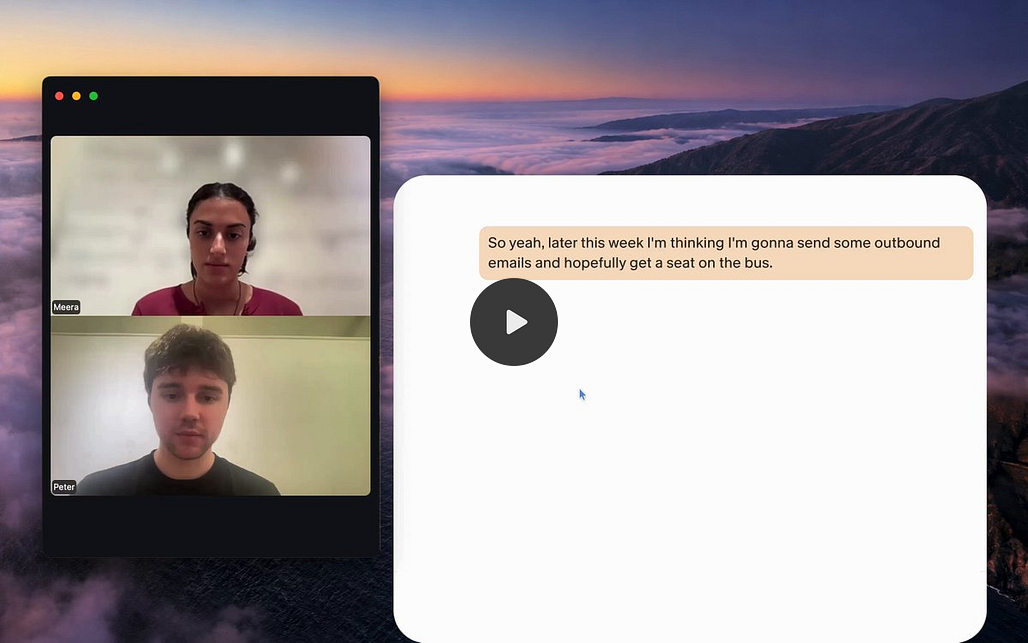
At the moment, the company runs a local model, trained on the likes of open-source speech-to-text models such as OpenAI’s Whisper and NVIDIA’s Canary, to generate sounds. The company said that it is working on improving the sounds.
This might be a bit extreme, but a valid first step to stop the behavior of non-consensual recording.
A few users presented some valid counterpoints. First, someone said that the sound is a bit jarring, and it could throw users off. Another person mentioned that they couldn’t hear the person in the demo at all. Baradari said that the plan is to work with beta testers and improve the model.


Second is the accessibility angle. Users who have hearing impairments often use transcription or note-taking software to help them during and after conversations.

There are a few solutions to this: for instance, a person with a hearing impairment can declare to others during/before the meeting that they use notetakers to help them. That would have people turn Kalypta or any equivalent off.
Notably, researchers have worked on adversarial attack tools on audio recognition models, but Kalypta is one of the first productizations of this concept.
As meeting recording increases, we will see more of these solutions being launched. On the other hand, meeting notetakers will face pressure from users and maybe lawmakers to properly indicate recording or transcribing.
Numbers Game
Wispr said that in its early days post-launch, its notetaker has transcribed over 2.5 million meetings.
A new report from CallMiner said that while CX companies are heavily using automation, only 24% said it delivers a positive customer experience.
Deals Corner
Nuance Labs ($50 million): AI avatars with natural human expression for real-time interaction.
Investors: Lightspeed Venture Partners (lead), Accel, South Park Commons, NVIDIA (NVentures), Define Ventures
Neosapience ($23 million): South Korea-based AI voice-generation company to power virtual characters
Investors: Public investors via KOSDAQ IPO
VozAI ($20 million): Brazilian AI startup building voice technology tailored for Portuguese and Spanish languages.
Investors: SoftBank Latin America Fund (lead)
Treble ($18 million): Iceland-based voice simulation platform for acoustic testing, synthetic audio data, and voice AI model evaluation with customers like Amazon and Logitech.
Investors: Paladin Capital Group (lead), KOMPAS VC, Frumtak Ventures, EIC, Omega ehf
Aristotle ($5 million): Voice-first AI tutoring platform for students ages 13-18.
Investors: True Ventures, Wicklow Capital
Hellobot ($1.3 million): Polish startup building AI voice agents that automate phone-based customer service for enterprises.
Investors: Lowercap (Lower Silesian regional fund), private angel investors
Thank you for tuning in. Keep listening.
This newsletter is by Ivan Mehta, a freelance reporter at TechCrunch. It covers AI and technology in voice, audio, and music. Email: voiceaiweek@gmail.com or im@ivanmehta.com