

India’s Reliance Jio bets big on voice AI, but there are privacy questions.
India’s telecom network Jio, owned by the Reliance conglomerate, comes up in every discussion around how it revolutionized data access and made it possible for many users to start using the internet en masse. The company, which is filing for an IPO, is now leaning heavily into voice to make AI accessible to its user base of over 500 million.
The company promises that people using Jio’s network will be able to access AI without needing any extra app and directly on calls. Users will be able to just call up the assistant by saying “Hey Jio” on the call and follow it up with a request to transcribe a call, create action items, place food orders, and more. This raises privacy questions about how Jio is listening in on the call for requests and how much data it retains. Will there be a way to turn off Jio AI for me?
Indian laws would allow users to transcribe a call for personal usage or safety, but usage beyond that without the consent of other people on the call can land you in legal trouble. Also, what happens when you place an international call in a territory where you need two-party consent for recording?
Jio showed a short demo of its voice AI functions during its Annual General Meeting (AGM) of shareholders, and I have questions about how some of that would work in real life.
The demo showed a person in the office on a call, asking Jio’s assistant to add “Rohan, Priya, and Kavya to this call,” and the assistant did its job. But how did it know which Rohan, Priya, and Kavya to add? Did it have access to the person’s phonebook? And if yes, are these the only contacts with these names? It seems unlikely because these are common first names in India.

Moments later, the person on a call with their family asks the Jio assistant to order a pizza. The company said that the assistant knew about the person’s usual outlet without specifying how. It even prompted the person to add Campa Cola, which is a Reliance-owned product. Will the assistant always promote company-owned products? What if I ask it never to recommend Campa Cola?

Jio’s premise is that users in India use voice a lot to chat with each other and with companies. Placing an AI assistant without having them install an app is one of the best ways to get distribution. There are clearly big questions about how the assistant would work, both in terms of execution and data privacy for users.
The company is also introducing voice AI across its apps and ecosystem for mobile recharge, customer support, installation help, roaming and eSIM activation. These use cases are app-based or call-based, so they seem much more plausible and consent-based than the on-network AI assistant.
Jio also showed off a new device called JioTeleFrame, which is a tablet that sits on a wall in your home and shows you reminders, schedules, and weather alerts. Jio calls them agents, but that’s a bit far-fetched. At one point, the demo showed two people talking about planning a festival lunch, and one person asked, “Hey Jio, did you get that?” and the tablet showed a potential lunch menu. Was the tablet listening all along? How would a guest know that a device was listening to them?
The company shows that the tablet can listen to you from a distance, which would be fantastic, because even my Echo devices with multiple mics make mistakes in understanding my voice at a few feet of distance.

The tablet can control the TV, smart home, place shopping orders on JioMart, and possibly talk to other Jio apps and devices. The idea of a central controlling and information device is not new, but in India, where a lot of information is fragmented, it will have to pull a lot of weight to work.
Jio has realized that voice could be a big part of India’s AI story. The company has resources and scale to reach millions of consumers. However, these products will need to perform in real life and not in demos, which would be a tough task to get to.
Signals & Experiments
AI companies are in a race to build AI voices that sound more “human.” These voices would ideally have more texture, timbre, expressiveness, and natural tonality. The core idea is that the more human these AI voices sound, the more likely that actual humans would want to talk to them for use cases ranging from customer support to therapy bots.
It is hard to quantify the “humanness” of a voice model. But that is what Vapi’s new experimental index aims to do. The voice AI pipeline company has built a site where users can listen to a pair of the same voice cloned to different models and pick one based on which one sounds more human. They can carry on doing this for different pairs. Based on these blind votes, Vapi is giving ratings along with a “humanness” score to these models.
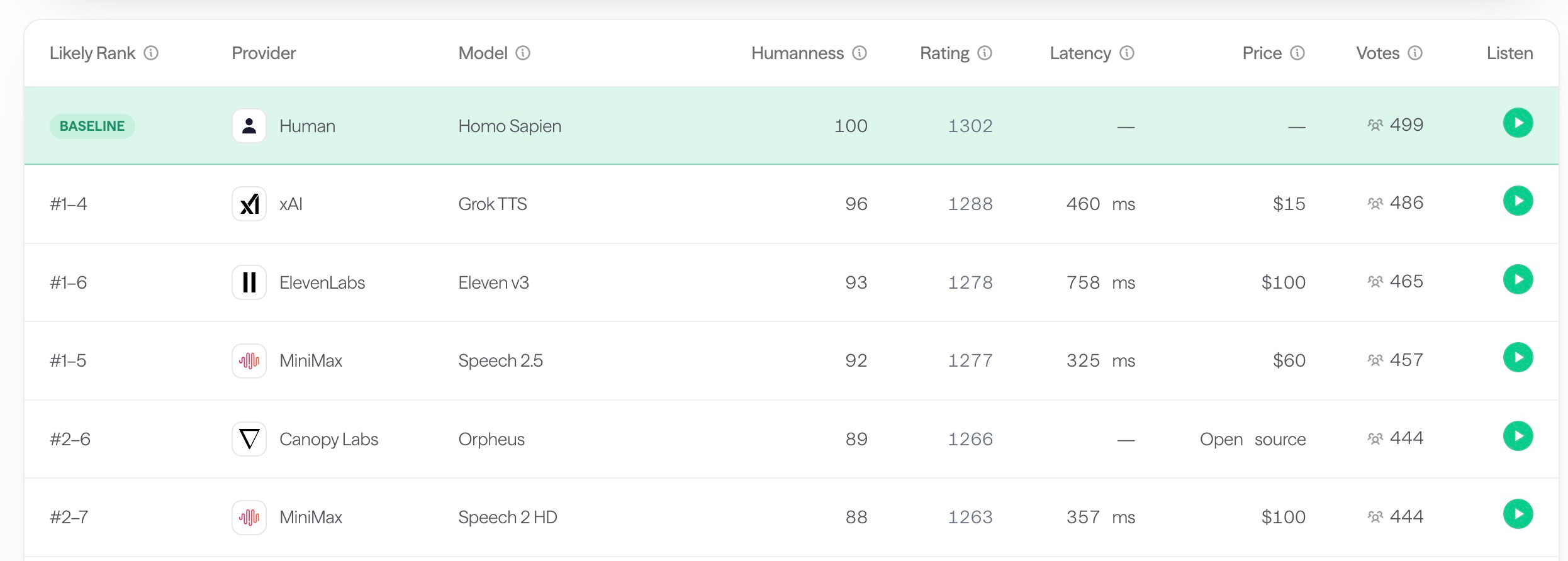
At the time of writing this newsletter, xAI’s Grok TTS is the leader, followed by ElevenLabs’ Elevenv3 and Minimax’s Speech 2.5. But these ratings can change as more votes come in. The index also shows latency and pricing for comparison.
Quick Bytes
There is a new bipartisan bill in the U.S. that would allow citizens to protect their voice from unlawful AI usage. Critically, Google and OpenAI are both supporting this bill. Notably, Denmark gave similar rights to its citizens last year.
Voice AI company Bland raised $50 million in Series C funding led by Dell Technologies. Fortune noted that the company runs its own models on controlled infrastructure for regulated industries like healthcare. Bland now handles over 3.5 million calls per week and tackled over 175 million calls last year.
Zoom is adding more voice integration to its suite. Users will be able to use voice commands to start meetings soon. The company also said that this year, it will roll out a feature that will intelligently tag speakers in a call.
India’s Sarvam, which has multiple voice models and an agent platform, closed a $234 million funding round led by HCLTech. While the company is building large language models from the ground up, it has released multiple voice models that are proficient in Indian languages.
Hardware voice AI notetaker Plaud said that the company is at $100 million ARR from its software subscription business. It has sold more than 2 million of its note-taking devices. Bloomberg noted that the company is targeting $500 million in sales, and new devices are on their way.
Apple patched a bug in Beats Studio earbuds that could turn them into a tapping device, according to Malwarebytes. The report noted that attackers could listen in to coversations and also impersonate trusted headphones to other devices.
Partner Spotlight with Atomik Growth
In a chat with a16z, ElevenLabs CEO Mati Staniszewski talks about how he and his co-founder, Piotr Dabkowski, got inspired to solve for badly dubbed movies and created a company that thinks that voice is the new interface for human-computer interaction.
Sponsored content
Thank you for tuning in. Keep listening.
This newsletter is by Ivan Mehta, a freelance reporter at TechCrunch. It covers AI and technology in voice, audio, and music. Email: voiceaiweek@gmail.com or im@ivanmehta.com